
Hard Water Stain Removal · Southern NH & North-Central MA
Hard Water Stain Removal
When windows still look cloudy after they have been cleaned, the residue is mineral, not dirt, and washing them again will not change it.
At Joslin & Co, we restore glass clouded by hard water deposits for homeowners and property managers across southern New Hampshire and north-central Massachusetts. Hard water leaves lime and other mineral deposits bonded to the surface of the glass, and once that happens standard window cleaning stops working. Soap and a squeegee will not lift it. Restoration is a different service with a different method, and it is the right call when your windows still look dirty after they have been cleaned.
How to tell whether you need restoration or just a cleaning
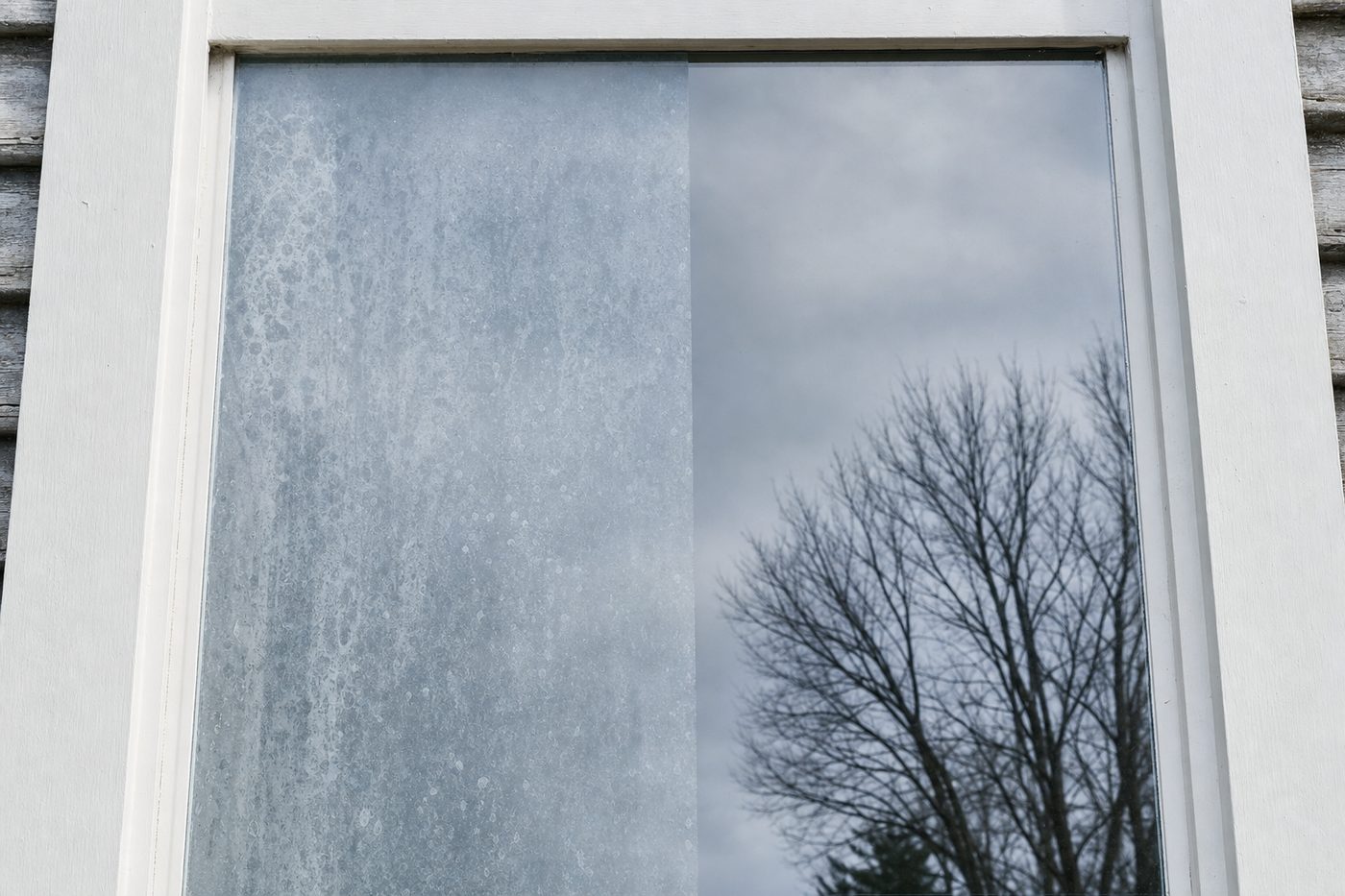
The test is simple and you can run it yourself. Have the windows cleaned properly, then look at them once the glass is fully dry. If the cloudiness, spotting, or milky haze is still there, the problem was never dirt. Dirt washes off. Mineral scale does not.
This matters because the two services are not priced the same and are not the same amount of work. If your glass has simply not been cleaned in a long time, you may not need restoration at all. A standard clean may be enough, and it is the cheaper and less involved service. We will tell you which one you are actually looking at when we see it.
| Standard window cleaning | Hard water restoration | |
|---|---|---|
| What it removes | Surface dirt, dust, pollen, grime | Bonded lime and mineral deposits |
| Method | Wash and squeegee | Polishing and abrasive treatment |
| Works on | Routine soiling | Mineral scale that washing leaves behind |
| Labor | Routine | Significantly higher |
| Risk to glass | Low | Real. Abrasive work can damage the surface |
| Quoted | Per clean | Separately, after inspection |
Why it happens here
Most hard water advice online was written for Utah and Arizona
Almost all of the hard water content you will find online comes out of the Southwest, where municipal water is genuinely hard. That is not this market. Municipal supplies across southern New Hampshire and north-central Massachusetts are comparatively soft, so if you are on town water and reading advice about extreme water hardness, it will not match what you are seeing.
Mineral staining on glass in New England usually comes from somewhere else entirely, and knowing which source you are dealing with changes whether the problem comes back after it is fixed.
Private wells
A large share of households in this region draw from private wells with no municipal treatment. Well water carries calcium and magnesium, and often iron as well. Iron produces the orange or rust-toned staining that people usually assume is something else. If the house is on a well and the stains return after cleaning, the water is the source.
Sprinkler and irrigation overspray
This is the most common preventable cause. An irrigation head that reaches the glass deposits minerals on it several times a week, and the water dries on the surface every time. Irrigation lines also frequently bypass whatever softening the house has, so the water hitting the windows is harder than the water coming out of the taps. Adjusting a single sprinkler head often solves a problem that otherwise recurs every season.
Concrete, mortar and masonry runoff
Water passing over concrete, mortar, or new masonry picks up alkaline compounds and carries them onto the glass below. This is why hard water staining and post-construction damage so often show up on the same building. Runoff from a new foundation, a repointed chimney, or a concrete sill can etch glass that was fine before the work started.
Winter road salt
Ground-floor and street-facing glass in this region takes salt spray through the winter. It is not lime scale, but it behaves similarly: it bonds, it does not wash off cleanly, and left through a season it dulls the surface.
How bad is it
Mineral staining progresses in stages, and the stage decides the method
Not every cloudy window needs the same treatment. What the glass needs depends on how long the deposits have been there and how far they have gone into the surface, which is the main reason this service cannot be quoted accurately over the phone.
| Stage | What you see | What it takes |
|---|---|---|
| Light film or early spotting | Faint haze or scattered spots, glass still looks clear at an angle | Often responds to specialist treatment without heavy abrasion |
| Built-up scale | Visible white or grey cloudiness that does not wash off, rough to the touch | Polishing and abrasive treatment |
| Etched glass | The deposit has bitten into the surface; haze remains after the mineral is gone | The most involved case, and results depend on depth |
Because the outcome varies with the stage, we look at the glass before committing to a result. We will give you an estimate on the phone, but we will not promise an outcome we have not seen.
Why vinegar, CLR and a scrub pad usually stall
Household remedies are the first thing most people try, and they tend to work on the very lightest film and then stop. Acidic cleaners can loosen surface deposit, but they do not remove bonded scale, and they do nothing at all for etching. The bigger problem is what people reach for next: a scouring pad, a razor blade, or an abrasive powder used without any judgment about the glass. That is how a cosmetic problem turns into permanent scratching.
The work itself
Restoration is abrasive work, and that is exactly why it matters who does it
Removing bonded mineral deposits can require polishing and abrasive cleaning of the glass surface. That is a meaningful step up from routine cleaning, and it is why the service is quoted separately.
It is also the reason the choice of company matters more here than on a normal clean. Abrasive work on glass is precisely where glass gets damaged. Done without the right read on the surface, abrasive treatment leaves the window worse than it started, and unlike a streak, that is not something anyone can come back and fix. This is not a job to hand to whoever quotes it fastest.
Coated and treated glass
Modern windows are frequently coated, and low-emissivity coatings can sit on surfaces that are not obvious from the outside. Treatment that is fine on plain annealed glass is not automatically fine on a coated or tempered unit. This is part of what gets checked before work starts rather than discovered during it.
Stopping it coming back
Restoration removes what is on the glass. It does not change what is landing on it. If the source is an irrigation head, a well, or runoff from masonry, the staining will return on the same schedule it arrived on unless the source is dealt with. We will tell you what we think the source is, because a restoration that has to be repeated every year is not a good outcome for anybody.
Why homeowners and property managers hire us for it
The insurance question matters more on abrasive work than anywhere else
Nico Joslin has cleaned windows for ten years and founded Joslin & Co in March 2024. There is more about the company if you want it. Joslin & Co is owner-operated, and the same cleaners return to the same property, so the person making judgment calls about your glass is not a stranger sent out that morning.
Joslin & Co carries $1,000,000 in general liability coverage and workers’ compensation, and a certificate of insurance is available on request.
On a service that involves taking abrasive tools to glass, that coverage is not paperwork. It is the specific answer to the specific risk. General liability covers damage to your property. Workers’ compensation covers the person doing the work: if an uninsured cleaner is injured on your property, off a ladder or off a roofline, that claim can reach your own policy. Plenty of small operations in this trade carry liability and skip compensation coverage, because it is expensive and often not required at small headcount. We carry both.
It is a fair question to ask every company that quotes you, and worth asking before the abrasives come out.
How it works
We quote it and complete it on the same visit
Hard water restoration cannot be priced accurately over the phone. How far the deposits have progressed, what the glass is, and what it will take has to be seen.
- Call or send the form. We explain how the service works.
- We come out and look at the actual glass. The stage of the deposit, the type of glass, and what it will need.
- We quote it on site.
- We do the work on that visit. There is no separate estimate appointment and no second trip.
- You are messaged the day before we come, so the arrival is never a surprise.
Quoting and completing on one visit is deliberate. Most companies in this trade send someone to look, then schedule the job for another day.
Who this service is for
Homeowners whose windows look cloudy or spotted after a normal cleaning, and property managers dealing with the same problem on storefront or building glass. It is the right service when washing has already been tried and has not solved it.
For commercial buildings we work up to five stories. Above that you will need a company set up for greater height, and we would rather say so than take the job.
Common questions
Hard water stain removal questions
Are hard water stains on windows permanent?
It depends how far they have gone. Surface deposit and built-up scale can generally be removed. Once the mineral has etched into the glass, the deposit can be taken off but the etching itself is a change to the surface, and how much of that improves depends on depth. Anyone promising a specific outcome before looking at the glass is guessing.
Will vinegar remove hard water stains from glass?
It works on the lightest film and stalls on anything bonded. Acidic household cleaners can loosen surface deposit but do not remove established scale and do nothing for etching. The risk is what people try next. Scouring pads, razor blades, or abrasive powder used without judgment about what the glass can take.
Can I use a razor blade or a Magic Eraser on my windows?
Both can scratch glass, and on coated or tempered units the damage is permanent. A blade in particular can drag a hard particle across the surface and leave a line that cannot be polished out. This is the single most common way a cosmetic problem becomes an expensive one.
Why do my windows have hard water stains if we have soft town water?
Because the water hitting your windows usually is not your tap water. The common sources here are sprinkler and irrigation overspray, runoff from concrete or masonry, private well water, and winter road salt. Municipal supplies across this region are comparatively soft, so if you are on town water the cause is almost always external.
Will a water softener stop the stains?
Only if the source is your household water. If the cause is irrigation overspray or masonry runoff, which it often is, a softener will not change what is landing on the glass. Irrigation lines also commonly bypass the softener entirely.
Is restoration cheaper than replacing the windows?
Restoration is a fraction of the cost of replacing glass, which is the main reason it is worth trying first. We do not publish pricing because the stage of the deposit, the glass type, and the number of affected panes change the job substantially. We quote it on site.
Will restoration damage a low-E coating or void my window warranty?
This is exactly why the glass gets inspected before any abrasive work starts. Coated and treated units need a different approach from plain annealed glass. If there is a reason not to treat a particular window, we will tell you rather than find out during.
Can pressure washing remove hard water stains?
No. Pressure moves water faster; it does not break the bond between mineral scale and glass. It can also drive water into seals and frames. Bonded deposit needs mechanical removal, not force.
How often should windows be cleaned to prevent this?
Regular cleaning is the cheapest prevention there is, because deposits that are removed before they bond never become restoration work. Once or twice a year suits most homes here. Where the source is irrigation or well water, more frequent cleaning makes a material difference.
Do you work on commercial glass?
Yes. Storefronts and buildings up to five stories, with certificate of insurance on request and net-30 invoicing.
Where we work
Hard water stain removal by town
Joslin & Co is based in New Ipswich, New Hampshire, offers four window cleaning services, and provides hard water stain removal across southern New Hampshire and north-central Massachusetts. Each town below has its own page covering what the work involves there.
New Hampshire
Nashua, NH · Manchester, NH · Concord, NH · Keene, NH · Peterborough, NH · Milford, NH · Salem, NH
Massachusetts
Worcester, MA · Lowell, MA · Fitchburg, MA · Leominster, MA · Chelmsford, MA · Littleton, MA · Acton, MA · Concord, MA · Marlborough, MA
Get your glass looked at
If your windows still look cloudy after they have been cleaned, mineral deposit is the likely reason, and cleaning them again will not change it. We will tell you what stage it is at and what can realistically be done about it.