
Post Construction Window Cleaning · Southern NH & North-Central MA
Post Construction Window Cleaning
Paint, adhesive, mortar dust and construction debris bond to glass. Getting them off is abrasive work, and it is where windows get scratched.
At Joslin & Co, we clean windows after construction and renovation for builders, general contractors, property managers and homeowners across southern New Hampshire and north-central Massachusetts. Construction debris and paint get all over the glass during a build, and none of it comes off with soap and a squeegee. This is abrasive work. Steel wool and razor treatment, and it is labor-intensive.
Why the final clean is not just a window cleaning
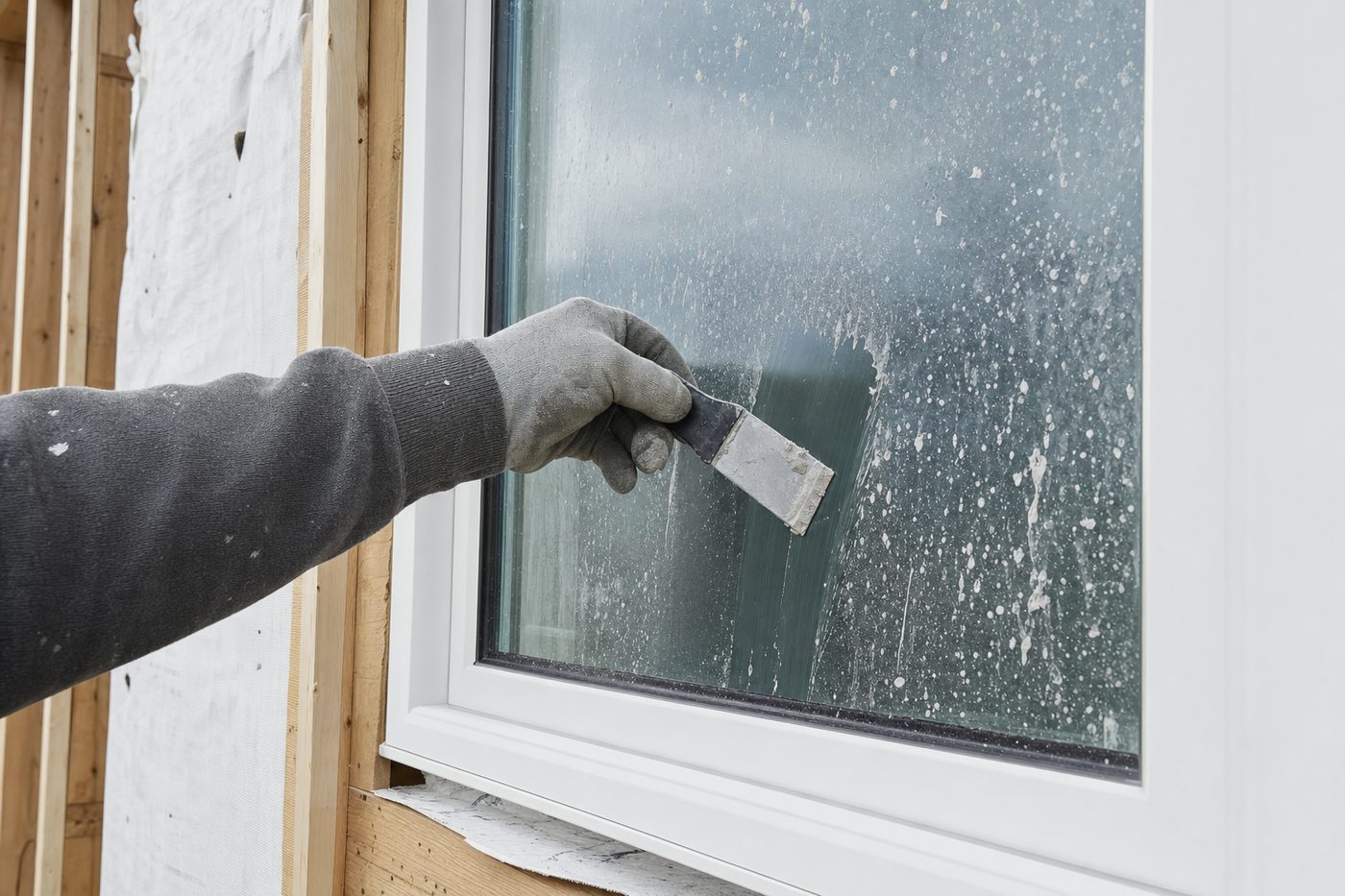
A routine clean removes what is sitting on the glass. After a build, most of what is on the window is bonded to it. Mortar splash, stucco, paint overspray, silicone, adhesive residue from film and stickers, drywall compound and concrete dust all cure onto the surface and stay there. A squeegee passes straight over them.
| What ends up on the glass | Why washing does not remove it |
|---|---|
| Paint overspray | Cures to a film bonded to the surface |
| Mortar, stucco and concrete splash | Alkaline, hardens on contact, can etch if left |
| Adhesive and label residue | Sticker and protective-film glue does not dissolve in detergent |
| Silicone and caulk smears | Repels water, spreads under a squeegee |
| Drywall compound and sanding dust | Fine, abrasive, and bonds when wet then dried |
| Metal filings from cutting | Embed in the surface and can rust in place |
Removing that lot means working the surface mechanically. It takes several times longer than a standard clean of the same building, and it carries risk that a standard clean does not.
The part most people never hear about
Fabricating debris: why new glass sometimes scratches during the final clean
This is the single most important thing to understand before anyone takes a blade to newly installed windows, and it is the reason post construction cleaning is treated as a specialist job rather than a cheap add-on at the end of a build.
Tempered glass is made by heating the pane and cooling it rapidly. During that process, small glass particles can fuse into the surface of the pane. The glass leaves the factory looking perfect, because the particles are microscopic and do not affect clarity or strength. They are called fabricating debris, or fines.
The problem appears when a blade passes over the surface. The particles dislodge, get caught under the edge, and drag. Leaving a scratch that follows the stroke. The scratch was not caused by carelessness. It was caused by a defect already present in the pane, and it can happen to an experienced cleaner working correctly.
How it is detected
Detection is tactile rather than visual. Fines produce a gritty feel and a distinct coarse sound under a blade. Someone who knows what that means stops. Someone who does not keeps going and scratches the window.
Why it is not resolved at the factory
Because glass carrying fines still meets the relevant industry standards, clarity and structural integrity are unaffected, defective panes are not rejected at manufacture. The dispute between glass manufacturers and window cleaners over responsibility has run for decades, which is precisely why the trade handles it with paperwork rather than argument.
How we handle it
We use a glass scratch liability waiver on jobs involving significant scraping. That is standard practice in the trade for exactly this reason, and we would rather have the conversation before the work than after a scratch appears.
If you are a general contractor or builder, this matters to you more than to anyone: the final clean is usually the last trade on site, which means scratched glass gets blamed on whoever was holding the blade regardless of when the defect was introduced. Knowing your cleaner understands fabricating debris, checks for it, and documents it is worth more than a lower line item.
Who this is for
New builds, renovations, and everything with a certificate of occupancy behind it
Post construction window cleaning covers a wider range of situations than most people expect, and the buyer is different in each.
General contractors and builders
The final clean before handover or a certificate of occupancy. What matters here is scheduling that holds, a crew that will not create a punch-list item, insurance documentation, and net-30 invoicing.
Homeowners after a renovation
Additions, window replacements, new siding, a repointed chimney, or interior work that left drywall dust and paint on the glass. Often the last thing standing between the project and being finished.
Property managers
Tenant fit-outs, storefront build-outs, and common-area work. Storefront glass takes the worst of it because it sits at street level through the whole build.
Anyone with a new house
New construction glass arrives covered in labels, protective film adhesive, and whatever the trades left. It is also the glass most likely to carry fabricating debris, because it has never been cleaned before.
When in the build it should happen
The final clean belongs at the end, after the last dusty trade has finished. Booked too early it gets undone by whoever comes next, and you pay twice. If exterior masonry, painting, or sanding is still to come, that work should finish first.
One thing worth flagging on longer builds: mortar splash and concrete runoff left on glass for months can etch the surface. If the build has been running a while and the windows have never been touched, the job may involve restoration as well as cleaning.
The work itself
Steel wool, razor work, and knowing when to stop
Bonded construction residue does not respond to detergent. Removing it means working the surface mechanically, steel wool and razor treatment, and doing it in a way that takes the debris off without taking the glass with it.
That is the whole skill in this job. Everything hard enough to remove cured paint and mortar is also hard enough to damage glass, which is why the sequence, the lubrication, the angle, and above all the feel of the surface under the blade matter more than speed.
It is also why the price is different. This is several times the labor of a routine clean on the same building. It is harder on materials, and it carries real risk. Anyone quoting post construction cleanup at standard window cleaning rates has either not seen the glass or is planning to rush it.
What gets cleaned
Interior and exterior glass. On residential work, storm windows and screens are covered as well. Anything beyond the glass itself we will confirm with you when we look at the job. Scope after a build varies more than it does on a routine clean.
Where restoration overlaps
If mortar or concrete runoff has been sitting on the glass long enough to etch it, cleaning alone will not restore clarity. That crosses into hard water and mineral restoration, which is a different treatment. We will tell you if that is what you are looking at rather than scrubbing at it and hoping.
Credentials
Insured for the work, and specific about it
Nico Joslin has cleaned windows for ten years and founded Joslin & Co in March 2024. There is more about the company if you want it. Joslin & Co is owner-operated and the same cleaners return to the same site.
Joslin & Co carries $1,000,000 in general liability coverage and workers’ compensation, with a certificate of insurance available on request and net-30 invoicing for commercial and contractor accounts. Technicians are uniformed.
For a general contractor that combination is the whole point: a subcontractor who can produce a COI, carries compensation coverage on the person on the ladder, invoices on terms, and will not turn the final clean into a punch-list item.
Workers’ compensation is worth being specific about. General liability covers damage to the property. Compensation covers the person doing the work, and an uninsured cleaner injured on site becomes somebody else’s problem, usually the property owner’s. Plenty of small operations in this trade carry liability and skip compensation. We carry both.
How it works
We look at it, quote it, and do it on the same visit
Tell us what is on the glass, roughly how many panes are affected and how long the build has been running, and we can give you an estimate over the phone. The firm price comes when we see it.
- Call or send the form. We explain how the service works.
- We come out and assess the glass. What is on it, whether anything has etched, and whether the panes need checking for fabricating debris.
- We quote it on site, and cover the scratch waiver before any scraping begins.
- We do the work on that visit where scope allows. No separate estimate appointment, no second trip.
- You are messaged the day before.
For commercial buildings we work up to five stories. Above that you will need a company set up for greater height, and we would rather say so than take the job.
Common questions
Post construction window cleaning questions
What is post construction window cleaning?
It is the removal of construction residue bonded to glass. Paint overspray, mortar and stucco splash, adhesive from labels and protective film, silicone, drywall dust and metal filings. It is done with steel wool and razor work rather than detergent, because none of that material washes off.
Why does it cost more than a regular window cleaning?
Because it is several times the labor on the same building, it is harder on materials, and it carries genuine risk to the glass. A routine clean removes what is sitting on the surface. This removes what has bonded to it.
Can regular window cleaning remove paint overspray?
No. Cured paint is bonded to the glass and a squeegee passes over it. It needs mechanical removal.
Can you use a razor blade on tempered glass?
Carefully, and only after checking the surface. Tempered glass can carry fabricating debris, particles fused into the pane during manufacture, which dislodge under a blade and drag, scratching the glass. Detection is by feel and sound. This is why we use a scratch liability waiver on jobs involving significant scraping.
Who is responsible if the glass gets scratched during the final clean?
This is a long-running dispute in the trade, because glass carrying fabricating debris still passes industry standards and is not rejected at manufacture, so the defect arrives with the window and only shows up when a blade touches it. We handle it the way the trade handles it: a signed glass scratch liability waiver, discussed before the work rather than after.
When should windows be cleaned after construction?
At the end, after the last dusty trade has finished. If exterior masonry, painting or sanding is still to come, that should finish first. Otherwise the clean gets undone and you pay twice.
What if the windows have been dirty since the build started?
Mortar splash and concrete runoff left on glass for months can etch the surface. If that has happened, cleaning alone will not restore clarity and the job crosses into mineral restoration. We will tell you which one you are looking at.
Do you work with general contractors and builders?
Yes. Certificate of insurance on request, workers’ compensation, uniformed technicians and net-30 invoicing.
Do you clean the frames and tracks as well?
Yes. Frames, sills and tracks, where construction dust collects. On residential work, storm windows and screens are covered too.
How high can you go?
Up to five stories. Above that you need a company set up for greater height, and we would rather tell you that than take the job.
Where we work
Post construction window cleaning by town
Joslin & Co is based in New Ipswich, New Hampshire, offers four window cleaning services, and provides post construction window cleaning across southern New Hampshire and north-central Massachusetts. Each town below has its own page covering what the work involves there.
New Hampshire
Nashua, NH · Manchester, NH · Concord, NH · Keene, NH · Peterborough, NH · Milford, NH · Salem, NH
Massachusetts
Worcester, MA · Lowell, MA · Fitchburg, MA · Leominster, MA · Chelmsford, MA · Littleton, MA · Acton, MA · Concord, MA · Marlborough, MA
Book the final clean
Tell us where the build is and what is still to finish, and we will come out, look at the glass, and quote it. On most jobs we complete the work on that same visit.