Hard Water Stain Removal · Concord, MA
Hard Water Stain Removal in Concord, MA
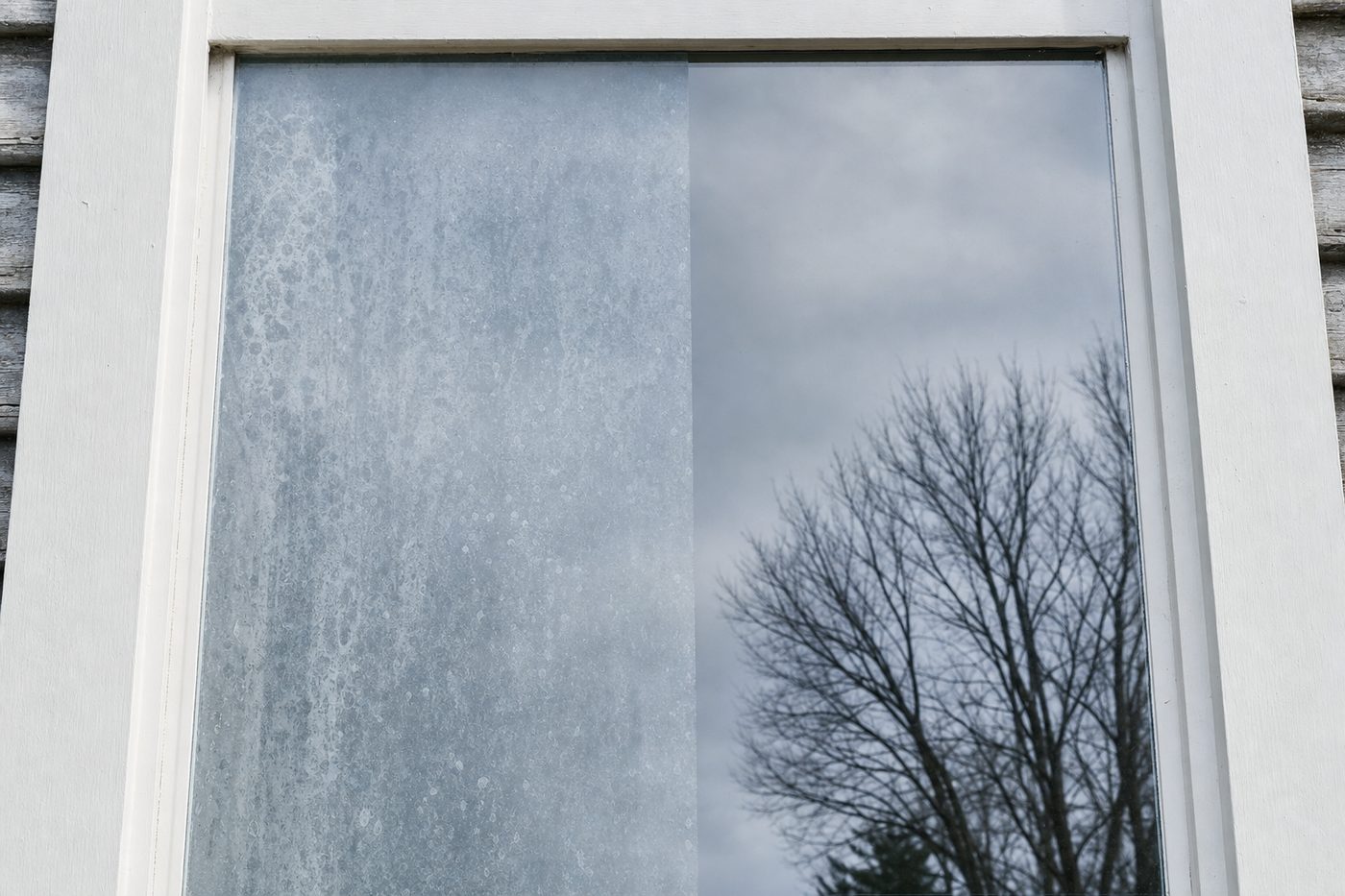
Cloudy white film that washing will not lift. Mineral deposit has to be worked off the surface, not cleaned off it. Assessed on site before anything is promised.
At Joslin & Co, we take mineral scale off glass for homeowners and businesses in Concord, Massachusetts. This is the cloudy white film that will not come off no matter how many times the window is washed, caused by lime deposits or other mineral deposits left on the surface. It is a separate service from window cleaning and it works differently.
What you are looking at is deposit, not soiling. Mineral scale forms where water carrying dissolved minerals dries on the pane: the water leaves, the minerals stay, and the same spot gets it again and again. That is why it accumulates instead of rinsing off like ordinary dirt.
Is that what you have?
How to tell mineral scale from the other things that look like it
Three different problems get described the same way on the phone, and only one of them is this one. You can usually work out which you have from where the haze sits.
| What you see | What it probably is | What it needs |
|---|---|---|
| A white or rainbow film on a surface you can put a finger on, worst at the bottom or in a fan-shaped pattern | Mineral scale | This service |
| Haze sitting between two panes that does not change when you wipe either side | A failed edge seal in a sealed insulated unit | A glazing repair. Nothing can reach it |
| Speckling, paint flecks or hard spots after building work | Construction residue | Post construction removal, which is a different service again |
The fan-shaped pattern is the giveaway for sprinkler damage in particular. If the film is heaviest low on the pane and spreads upward in an arc, something has been throwing water at that window on a schedule.
Why washing does nothing
This is deposit, not dirt, and detergent does not engage with it
Most people meet this by scrubbing harder, and it changes nothing. Soap moves material resting on a surface. Mineral scale has been laid down onto the surface instead, which is a different problem and needs a different answer.
There is a second reason this is worth dealing with rather than living with. Deposit keeps building as long as the source keeps hitting the same glass, and an older, thicker film is harder work than a newer one. Time does not help here.
What removal involves
Working the surface, and testing before committing to it
Taking mineral scale off can require polishing and abrasive cleaning instead of a wash. The work happens on the glass surface, using compound and a pad, and it is slower and more deliberate than ordinary window cleaning by a wide margin.
That is also why it starts with a test patch rather than a full attack. Treat a small area, read what happens, then decide. Predicting the outcome down the phone is not something we are willing to pretend to do.
We are not going to tell you on a web page what your glass will look like afterwards. How far a given pane comes back depends on how long the deposit has been there and what it has done to the surface underneath, and anyone quoting a result sight unseen is guessing. What we will do is look at it and tell you straight.
Why timing matters
Deposit on the glass, and damage in the glass
Deposit is not the end of the story, and the next stage is the reason waiting is a bad idea.
At first mineral scale rests on the surface. Given long enough, and in the wrong conditions, the minerals can start acting on the glass itself and leave pitting or etching behind. Material sitting on the pane is one problem; the surface having been altered is another. That distinction is exactly why we test first rather than predict.
Where the water is coming from
Sprinklers and irrigation are the usual culprit here
The removal is only half of it. If whatever is putting mineral-bearing water onto that glass carries on doing it, the film returns.
| Source | Why it puts minerals on your glass |
|---|---|
| Lawn irrigation and sprinkler heads | The most common cause on a detached house. A head aimed even slightly high hits the same glass every cycle |
| Runoff from a roof or gutter overflow | Water crossing masonry or concrete picks up minerals on the way down |
| Hose spray and pressure washing | Washing the siding pushes mineral-bearing water onto the glass |
| Condenser and downspout splashback | Repeated wetting of the lower panes from ground level |
Once we have seen it, we will tell you what we think is causing it. Moving a sprinkler head is cheaper than doing this twice.
Keeping it off
The fix is usually a sprinkler head, not a chemical
Getting it off and keeping it off are two different problems. The second one is usually the cheaper of the two, since it generally means moving water away from the pane rather than doing anything to the pane.
| If the cause is | The fix is usually |
|---|---|
| A sprinkler or irrigation head hitting the glass | Re-aim it, lower the arc, or move it. This is the single most common cause and the single easiest fix |
| Gutter overflow running down the face of the building | Clear the gutter or fix the downspout so water goes away from the wall rather than across it |
| Runoff crossing masonry or sills above a window | Address the drip edge or flashing so water leaves the wall before it reaches the glass |
| Air conditioning condensate draining onto glass below | Redirect the drain line |
| Exterior washing pushing water across the panes | Rinse the glass with clean water afterwards rather than letting it dry where it lands |
We do not charge for any of this. If the cause is visible we will point it out, on the straightforward basis that somebody who fixes the source is not paying us to repeat the work later.
Before you hire anyone
Ask for both policies by name, not just “are you insured”
“Insured” is worth more on this service than on a standard window clean, because this is abrasive work on the surface of your glass.
General liability pays for damage to your property. Workers’ compensation pays for the person doing the work if they are hurt while they are there. Two separate policies, and a company can carry one without the other.
This is abrasive work directly on the glass surface, which is precisely what general liability is for. It is also why price alone is a poor way to choose on this service. Experience counts for more here than on a job where the worst outcome is a smear.
We carry both. $1,000,000 in general liability and workers’ compensation, and a certificate of insurance is available on request. Ask us for it, and ask everyone else for it too.
Nico Joslin has cleaned windows for ten years and started Joslin & Co in March 2024. It is family-owned and owner-operated, and it runs out of 61 Appleton Rd Unit 8, New Ipswich, NH 03071, which is a real address with a real phone behind it.
Questions
Common questions about hard water stain removal in Concord, MA
What does hard water stain removal cost in Concord, MA?
There is no starting figure for this one, because the variables are the extent of the affected glass, the thickness of the deposit and how long it has been accumulating. Those need looking at. Ring us and we will explain what happens next.
Will it come out completely?
That depends on the glass, and we are not going to promise you a result before we have seen it. How long the deposit has been building and what it has done to the surface underneath both matter. We test a small area first, and then we tell you what we think is achievable rather than what you want to hear.
Can I not just use vinegar or a descaler?
Vinegar and household descalers get recommended constantly and they are a poor idea on windows. Acidic products can etch glass and damage the coatings on modern units, and scouring powders and abrasive pads leave permanent marking. The risk is that a cosmetic problem becomes a permanent one.
Why did my window cleaner not get it off?
Because a window cleaner cleans windows, and this is not dirt. Washing removes what sits on glass. Mineral scale is deposited onto the surface, so it needs polishing and abrasive cleaning rather than detergent. It is a different job with different equipment.
What causes it in the first place?
Water carrying dissolved minerals drying on the same glass repeatedly. The water evaporates and the minerals stay. On a house that is usually irrigation or runoff; on a larger building it is usually water coming down off masonry or sills above the window.
Will it come back?
If the source keeps putting the same water on the same glass, yes. That is why we look at where it is coming from as well as taking it off. Often the fix is as simple as re-aiming a sprinkler head.
Is it safe on modern windows?
It has to be approached carefully. Some modern units carry a low-emissivity coating on the room-side surface that abrasives will mark permanently, which is one of several reasons this is tested on a small area before anything else happens.
Do you do this on commercial glass too?
Yes. Storefront and building glass gets the same deposit from the same causes, and it is assessed the same way.
Are you insured for this?
Yes. $1,000,000 in general liability plus workers’ compensation, with a certificate of insurance available on request. On abrasive work that matters more than it does on a standard clean.
Coverage
Concord, MA and the wider service area
Joslin & Co works out of New Ipswich, New Hampshire, across southern New Hampshire and north-central Massachusetts. Acton, MA and Marlborough, MA are also in the service area, and the full list is on the service areas page. If your town is not on it, ask.
Residential window cleaning in Concord, MA
Glass inside and out, screens and storm windows, from $250.
Commercial window cleaning in Concord, MA
Storefront glass on a schedule, and buildings up to five stories.
Post construction window cleaning in Concord, MA
Paint, mortar and adhesive bonded to glass after a build.
Hard water stain removal
How the service works across the whole service area.
Get your Concord, MA glass looked at
Send a photo or call and describe where the film sits on the pane. That is usually enough for us to tell you whether it is mineral scale, a failed seal or something else, before anyone comes out.