Post Construction Window Cleaning · Fitchburg, MA
Post Construction Window Cleaning in Fitchburg, MA
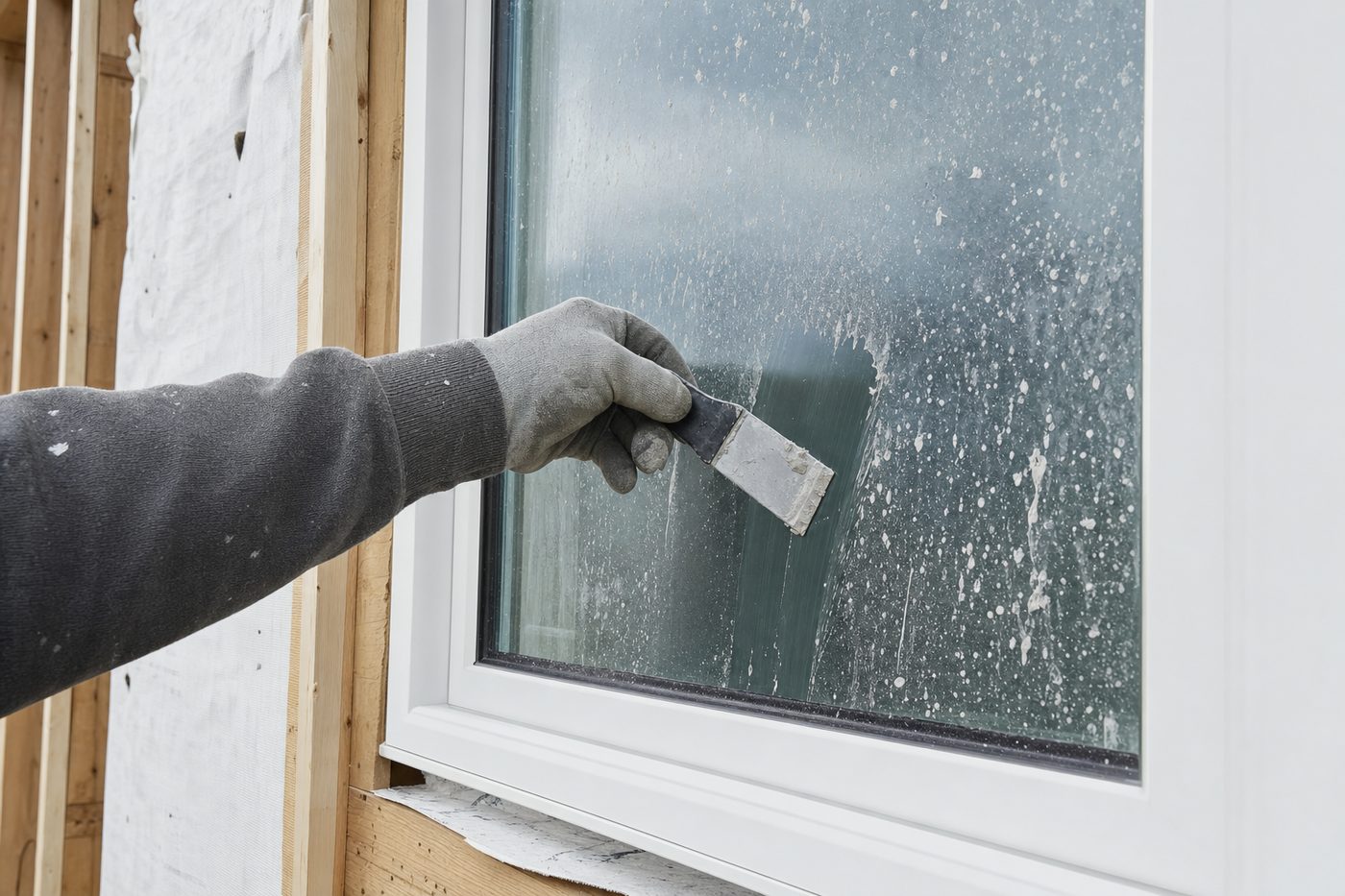
Paint, mortar, adhesive and stucco cut off the glass with steel wool and a razor. Not a wash. A glass scratch liability waiver is signed before any blade touches a pane.
At Joslin & Co, we do post construction window cleaning for builders, general contractors, renovators and homeowners in Fitchburg, Massachusetts. This is the job where paint, mortar, adhesive, silicone and stucco have to come off the glass after the trades are finished. It is abrasive removal work rather than window cleaning, and it is priced and handled differently.
Post construction glass is not dirty, it is contaminated. Paint has cured into a film, mortar has gone off, adhesive has set. None of that responds to detergent, so the job is removal rather than cleaning, and the method that removes it is the same method that can damage glass if the person holding the blade does not know what to look for.
Why a normal clean will not do it
Soap and a squeegee will not touch construction residue
The usual first attempt is soap and a squeegee, and it fails completely. Not partially, completely, because everything on the pane is bonded to the surface rather than resting on it.
| What is on the glass | Why washing fails |
|---|---|
| Paint overspray | Cured film bonded to the surface, not dirt sitting on it |
| Mortar and concrete splatter | Cementitious, and it etches the longer it sits |
| Adhesive and label residue | Needs solvent and a blade, not detergent |
| Silicone and caulk smears | Smears further under a cloth |
| Stucco and plaster | Hardens into a mechanical bond with the glass |
There is one more reason to get it off sooner rather than later. Cementitious residue keeps working on the surface it is sitting on, so mortar and concrete splatter etch the glass the longer they stay. A job booked as the trades finish is quicker and cleaner than the same job three months later.
How it is actually done
Steel wool and a razor, in that order, with the glass kept wet
Fine steel wool with plenty of water lifts the bulk of it and gives the surface a read. A razor takes what is left, kept wet, at a shallow angle, moving in one direction rather than scrubbing back and forth. Dry scraping is how glass gets ruined, and so is a blade used at the wrong angle by somebody in a hurry.
The work is slow and it is deliberate. There is no way to rush a blade across glass safely, which is why post construction pricing has almost nothing to do with how many windows there are and almost everything to do with what is on them and how long it has been there.
The part almost nobody explains
Fabricating debris, and why the scratch argument happens at all
There is a technical problem sitting underneath every scratch dispute in this trade, and it is worth understanding before you hire anyone, because most quotes will never mention it.
During manufacture, tempered glass passes through a furnace on rollers. Particles of glass can fuse to the surface in that process and stay there. They are a manufacturing defect and they are present before anybody cleans anything. Drag a blade over a pane carrying fabricating debris and those particles dislodge and travel under the edge, cutting the surface as they go.
The detection is tactile rather than visual. A pane with fabricating debris feels and sounds gritty under the blade, and that is the signal to stop and reassess rather than push on. The reason this argument recurs across the trade is that glass carrying these fines still passes industry standards, because the particles do not affect clarity or strength. So the pane is not defective by the standard, and the scratch is real, and the two facts sit there contradicting each other.
The practical consequence is a different way of working: test first, listen to what the blade is telling you, stop when the surface goes gritty, and settle the question of who carries the risk before anyone starts rather than afterwards. Hence the waiver.
How we handle the risk
We use a glass scratch liability waiver, and we would rather explain it than bury it
A glass scratch liability waiver is partly self-protection, and there is no point pretending otherwise. It is also the only honest response to a risk that was manufactured into the glass long before anyone quoted the job.
| What the waiver does | What it does not do |
|---|---|
| Puts the fabricating debris risk in writing before work starts | Excuse careless work or poor technique |
| Records that scraping is the only method that removes the residue | Remove our general liability cover for damage we cause |
| Makes the decision yours, with the risk stated | Get signed after the fact |
A signed waiver on heavy scraping work is normal in this trade. Ours gets explained and signed before anything starts, never retrospectively, because a waiver produced after a scratch is not a risk agreement, it is an excuse.
Who this is for
Builders, contractors, renovators and homeowners at handover
| If you are | What usually matters most |
|---|---|
| A general contractor | Getting the glass signed off at handover without a callback |
| A window or glazing installer | That somebody understands fabricating debris before a blade is used |
| A renovator | Old glass and new residue on the same job |
| A homeowner after a build | That the windows you paid for actually look new |
Whichever you are, the first call goes the same way. Tell us what is on the glass, how long it has been there, and whether the units are tempered, and we can tell you how it gets handled.
Where this work comes from in Fitchburg
Renovation produces the same glass as new build
Not much gets built new here. Only 9.6% of the housing has gone up since 2000, while 42.8% predates 1940. What that means is that this work arrives through renovation rather than new construction, and a gut renovation leaves glass in exactly the same state a new build does.
Either way the useful thing on the first call is not the window count. It is what is on the glass, roughly how long it has been sitting there, and whether the units are tempered. Residue that has had a summer to cure is a different job from residue a week old.
Before you hire anyone
Ask for both policies by name, not just “are you insured”
“Insured” matters more on this job than on any other kind of window cleaning, because this is the job where glass actually gets damaged.
General liability pays for damage to your property. Workers’ compensation pays for the person doing the work if they are hurt while they are there. Two separate policies, and a company can carry one without the other.
Abrasive removal is deliberate contact between a blade and a pane. That is precisely the situation general liability exists for, and it is why the cheapest quote on a post construction job is rarely the cheapest outcome. workers’ compensation matters for the same reason it always does: somebody is on a ladder on your site.
We carry both. $1,000,000 in general liability and workers’ compensation, and a certificate of insurance is available on request. Ask us for it, and ask everyone else for it too.
Nico Joslin has cleaned windows for ten years and started Joslin & Co in March 2024. It is family-owned and owner-operated, and it runs out of 61 Appleton Rd Unit 8, New Ipswich, NH 03071, which is a real address with a real phone behind it.
Questions
Common questions about post construction window cleaning in Fitchburg
What does post construction window cleaning cost?
It is quoted per job rather than from a starting price, because the variables are what is on the glass and how long it has been there rather than how many windows there are. A pane with a week of overspray and a pane with a summer of cured mortar are not the same job. Call and we will tell you what we need to know.
Can you not just wash it off?
No. Construction residue is bonded to the surface rather than sitting on it. Paint has cured into a film, mortar has gone off, adhesive needs solvent. Detergent and a squeegee move dirt, and none of this is dirt.
Will scraping scratch my windows?
Done properly on sound glass, no. The genuine risk is fabricating debris, which is particles fused into tempered glass during manufacture, before anyone cleans it. Those can dislodge under a blade and cut the surface. It is detected by feel, it is a manufacturing defect rather than cleaner error, and it is the reason we use a glass scratch liability waiver.
What is a glass scratch liability waiver?
A document signed before work starts that sets out the fabricating debris risk in writing, records that scraping is the only method that removes the residue, and leaves the decision with you. It is normal practice in this trade on any job involving significant scraping. It does not excuse careless work.
Why would glass with a defect still be sold?
Because fabricating debris does not affect how clear the glass is or how strong it is, so a pane carrying it still meets industry standards. That is exactly why the argument keeps happening: the glass is not defective by the standard, and the scratch is still real.
How do you know if glass has fabricating debris?
By feel and sound under the blade rather than by looking at it. A pane carrying it goes gritty, and that is the point to stop and reassess instead of pushing through. It is a large part of what experience is worth on this job.
How soon after the build should it be done?
Early, and the difference is large rather than marginal. Everything on the glass continues to cure, and mortar keeps working on the surface beneath it, so waiting turns straightforward removal into slow removal plus permanent marking. Book it as the trades finish.
Do you do this on new builds and renovations both?
Yes. A gut renovation leaves glass in the same state a new build does, and the removal is the same work either way.
Are you insured for this?
Yes. $1,000,000 in general liability plus workers’ compensation, with a certificate of insurance available on request. On abrasive work that is not a formality, it is the point.
Coverage
Fitchburg and the wider service area
Joslin & Co works out of New Ipswich, New Hampshire, across southern New Hampshire and north-central Massachusetts. Leominster, MA and Littleton, MA are also in the service area, and the full list is on the service areas page. If your town is not on it, ask.
Residential window cleaning in Fitchburg
Glass inside and out, screens and storm windows, from $250.
Commercial window cleaning in Fitchburg
Storefront glass on a schedule, and buildings up to five stories.
Hard water stain removal in Fitchburg
Mineral scale that a wash will not lift.
Post construction window cleaning
How the service works across the whole service area.
Get a price for your Fitchburg project
Call and tell us what is on the glass, roughly how long it has been there, and whether the units are tempered. That is enough for us to tell you how it gets handled and what it takes.